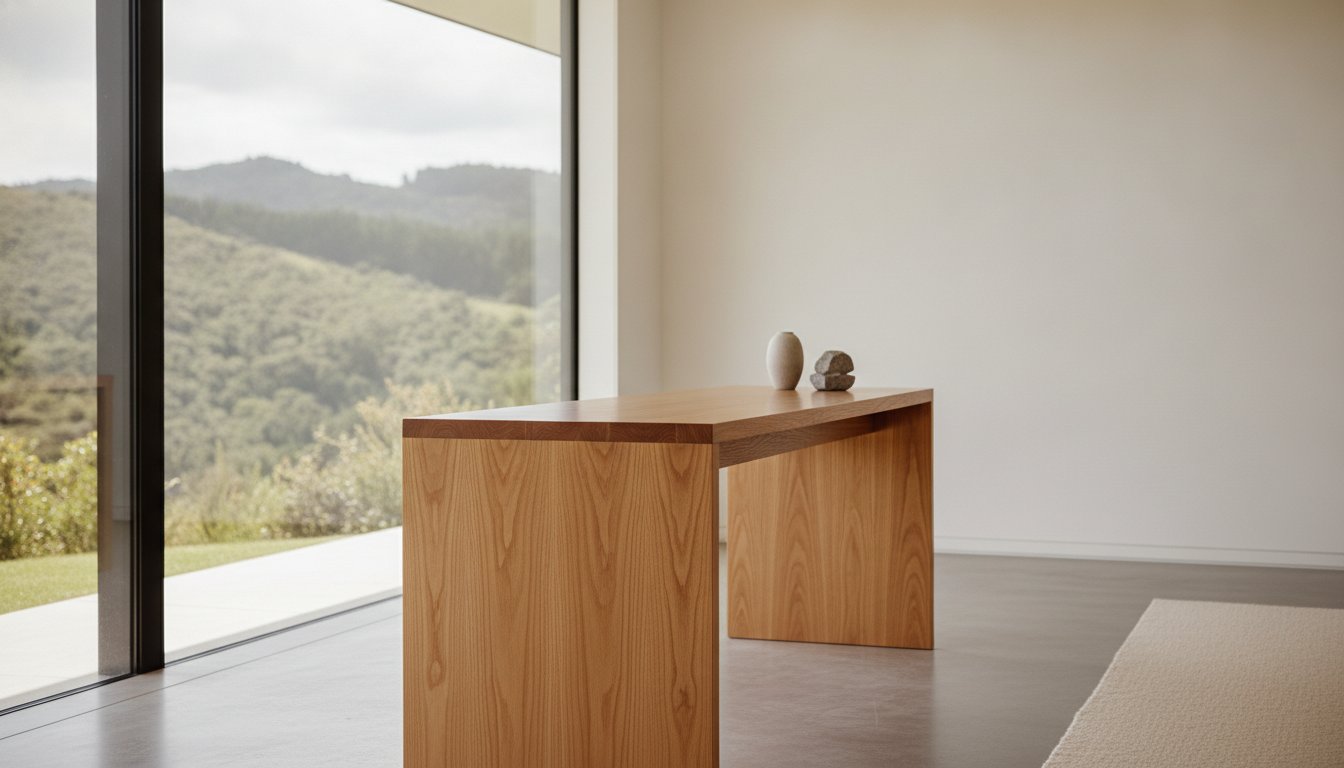
Solid Wood Furniture vs MDF: A Maker’s Guide to Quality and Longevity
30 August 2026 · 17 min read
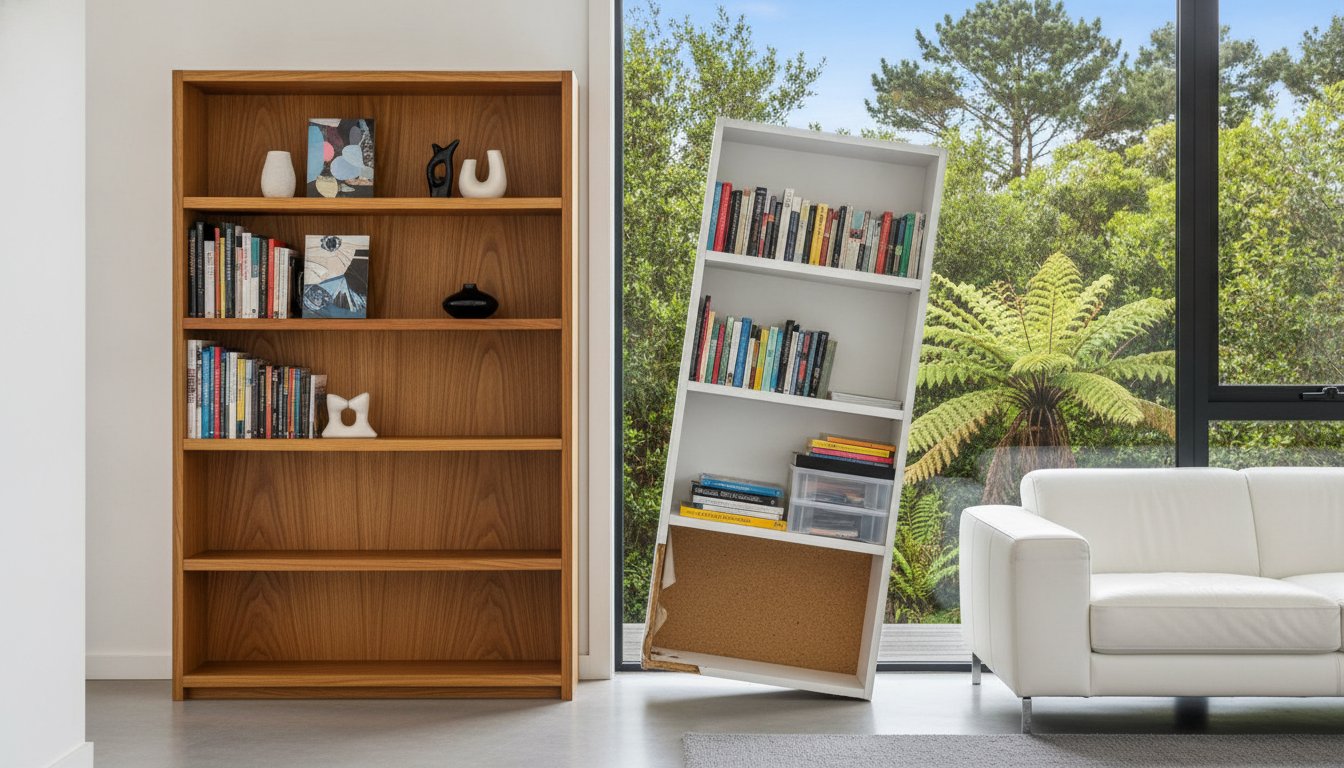
You’ve just finished moving house, and your flat-pack bookshelf is already leaning at a precarious angle. It’s a common frustration. You notice the edges are starting to peel or swell from a simple spill, and the structural integrity seems to have vanished after one trip in a van. When weighing up solid wood furniture vs mdf, it is easy to be swayed by the lower upfront cost of composite boards. However, the true cost of disposable furniture often reveals itself in the skip bin rather than the receipt.
In this maker’s guide, you will discover the structural and practical differences between solid timber and MDF to help you choose furniture that lasts a lifetime. We look at why solid timber can be sanded and repaired if scratched, while MDF often fails the repairability test. You will also learn about the environmental impact of your purchase and the significant 2026 formaldehyde emission standards that affect your home's air quality. By understanding these material truths, you can invest in pieces that hold their value and remain a functional part of your home for generations.
Key Takeaways
- Understand the fundamental differences between the natural cellulose fibres of solid timber and the resin-bonded wood fibres used in MDF.
- Evaluate the structural trade-offs of solid wood furniture vs mdf, focusing on how natural grain provides superior tensile strength and longevity.
- Learn why solid timber is a lifetime investment that can be sanded and repaired, whereas MDF panels are often disposable once damaged.
- Identify the health implications of urea-formaldehyde off-gassing and the environmental benefits of choosing biodegradable, sustainably sourced materials.
- Discover how precision CNC machining allows the EasyFit range to provide the convenience of flat-pack assembly with the integrity of solid timber.
Solid Wood vs MDF: Understanding the Core Differences
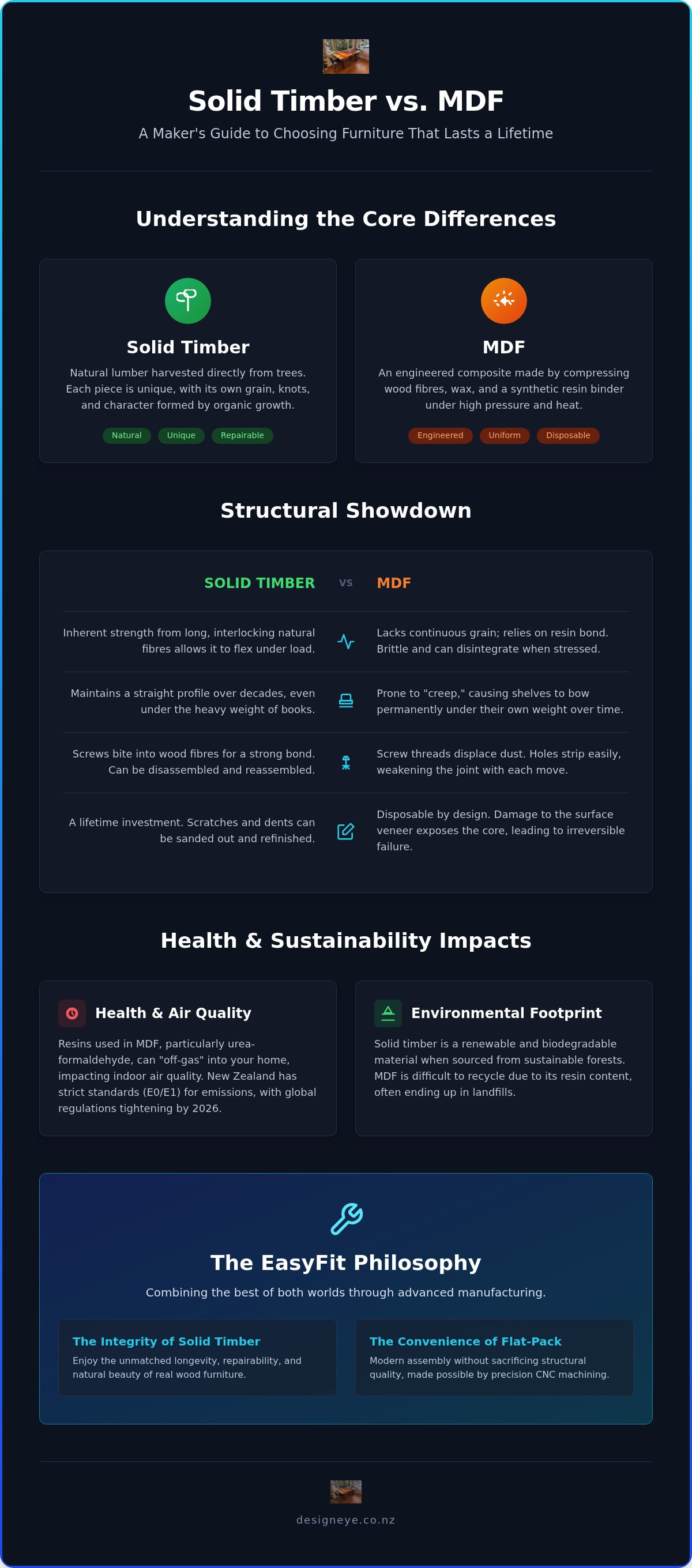
When you run your hand across a piece of furniture, the material tells a story. Solid timber is natural lumber. It's harvested, milled, and kiln-dried directly from a tree. Every plank retains the organic history of the wood, from growth rings to knots. In contrast, Medium-density fibreboard (MDF) is a composite product. It's manufactured by breaking down hardwood or softwood residuals into wood fibres. These fibres are combined with wax and a resin binder, then formed into panels under high heat and pressure.
The tactile difference is immediate. Solid timber has a warmth and a varied texture that feels grounded in a home. It's heavy and resonant. MDF is often just as heavy, but it feels inert. A common misconception is that "engineered" materials are inherently better because they're uniform. While uniformity makes mass production easier, it often ignores the structural resilience found in natural cellulose fibres. When weighing up solid wood furniture vs mdf, you're choosing between a material that grew and a material that was processed.
The Composition of Solid Timber
Every piece of solid timber is unique. The grain patterns aren't just aesthetic; they're the structural skeleton of the board. Different species offer varying levels of hardness and durability. We prioritise the milling process to ensure the timber's character is preserved while maintaining its utility. Moisture content plays a critical role here. We ensure timber is dried to a specific percentage to maintain stability in New Zealand's varied climate. This prevents the wood from moving excessively once it's in your home, a level of care that mass-produced composite boards simply don't require.
What is Actually Inside an MDF Board?
MDF is a structural compromise. Because it consists of compressed dust and glue, it lacks a continuous grain. This allows it to be cut into complex shapes without splintering, but it creates the "uniformity trap". Without a grain to provide tensile strength, the board relies entirely on the chemical bonding agent to hold its shape. MDF needs a veneer or a thick coat of paint to look like furniture. When you compare solid wood furniture vs mdf, you'll notice that MDF is essentially a blank canvas. It's a simulation of wood hidden under a surface finish. If that surface is breached by a scratch or moisture, the core is vulnerable and cannot be easily restored.
Structural Science: Why Grain Direction Matters for Longevity
Natural cellulose fibres are the secret to timber's resilience. These long, interlocking chains provide inherent tensile strength. They allow a board to flex under a heavy load and return to its original state without snapping. In contrast, MDF lacks this internal architecture. It is essentially compressed wood dust held together by synthetic resin. This leads to the "biscuit-crumb" effect. When the edges of an MDF panel are knocked or stressed, the lack of fibre continuity causes the material to disintegrate into small particles. When evaluating the structural science of solid wood furniture vs mdf, the differences in internal composition become clear.
Load-bearing capacity is another area where the materials diverge. Solid wood shelves maintain their profile over decades. MDF is prone to a phenomenon called "creep," where the shelf gradually bows under its own weight or the weight of objects. This sagging is permanent and often irreversible. Timber is built to support weight, while composite boards are primarily designed to provide a flat surface. Temperature changes also affect these materials differently. Natural fibres expand and contract predictably along the grain. Synthetic resins in composite boards can become brittle or lose their bond strength over time, especially in environments with fluctuating humidity.
Screw-Holding Capacity and Joint Integrity
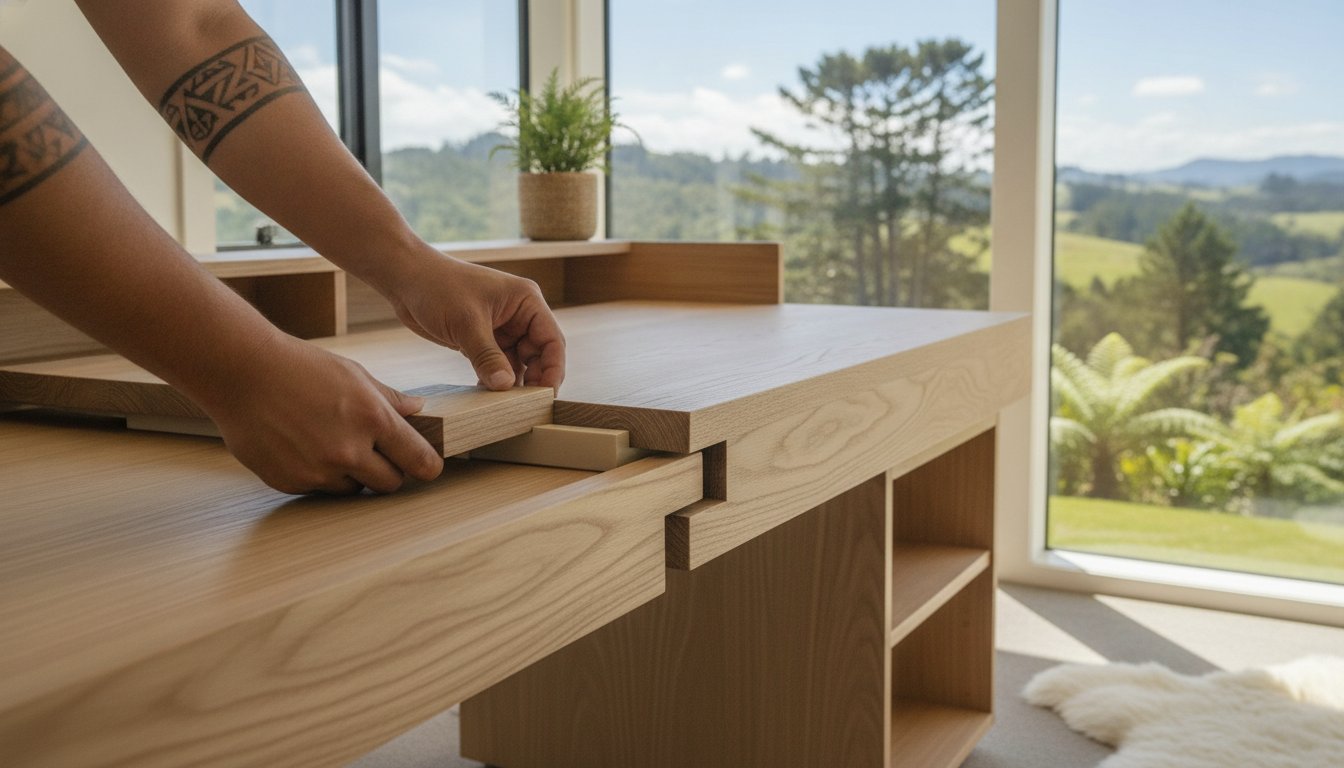
Mechanical fixings require a material they can bite into effectively. In solid wood, screw threads wedge between the natural fibres to create a permanent, high-friction bond. You can disassemble and reassemble a timber piece multiple times without losing structural integrity. MDF presents a challenge here. The screw threads simply displace the wood dust. If you over-tighten a screw or move the furniture once too often, the hole strips. It cannot be easily repaired. We use precision CNC machining to ensure our solid timber products fit together with millimetre accuracy. This precision minimises the reliance on fasteners alone, using the material's own strength to create a rigid, stable frame.
Weight and Density: More Than Just Heavy Lifting
High density doesn't always translate to high durability. MDF is incredibly heavy because of the high volume of resin used to bond the fibres. However, this weight is often "dead weight" that provides no real structural benefit. In solid timber, density is a result of years of natural growth and tight grain patterns. A weighted, stable piece of furniture provides a sense of permanence in a workspace. It doesn't wobble when you type or lean against it. This physical stability influences the overall feel of quality. It makes a piece feel like a tool rather than a temporary fixture. Choosing solid wood furniture vs mdf means investing in a material that uses its density to provide genuine stability and lasting utility.
The Cost of Convenience: Comparing Durability and Repairability
The "one-move" rule is a well-known reality for owners of composite furniture. When you disassemble an MDF desk to move house, the internal structure of the joint often fails. Because MDF is made of compressed fibres, removing a screw or cam lock tears the material's core. Reassembling it usually results in a wobblier, less secure piece. Solid timber doesn't suffer this fate. Its natural grain structure allows mechanical fixings to be removed and replaced multiple times without losing their grip. When comparing solid wood furniture vs mdf, the ability to move your furniture with you is a significant factor in long-term value.
Repairability is where timber truly excels. Life happens; coffee spills, keys scratch surfaces, and vacuum cleaners clip the legs of tables. If you scratch a solid wood surface, you can sand it back and re-apply a finish. The repair is invisible. With MDF, a scratch often penetrates the thin laminate or paint layer, revealing the brown, fibrous core underneath. There's no way to sand this back without destroying the surface. You're often forced to replace the entire panel, which is neither cost-effective nor sustainable.
Maintenance and Refinishing
Maintaining solid timber is a straightforward process of nourishment. A regular application of high-quality oil or wax keeps the wood supple and brings out the natural lustre of the grain. This isn't just about looks; it's about protection. If you decide to change your interior style in five years, you can strip and repaint or stain solid timber. MDF furniture is typically permanent. The factory-applied laminates and plastic coatings don't take new paint well, and the smooth surface is easily ruined by aggressive sanding.
Water Resistance and Environmental Stress
The "blown edge" is a common sight in kitchens and laundries fitted with composite boards. When moisture reaches the core of an MDF panel, the fibres absorb it and swell. This expansion is permanent; the board will never return to its original thickness once it has "blown." Solid wood reacts differently. It "breathes" with the humidity in New Zealand's climate, expanding and contracting slightly across the grain. While extreme moisture isn't good for any wood, solid timber doesn't disintegrate or swell irreversibly from a simple spill. Investing in solid wood furniture vs mdf means choosing a material that handles the realities of a lived-in home.
Health and Sustainability: What is Inside Your Furniture?
Choosing between solid wood furniture vs mdf involves looking beneath the surface finish. Most composite boards rely on synthetic resins as a primary bonding agent. These resins often contain urea-formaldehyde, which releases volatile organic compounds (VOCs) into your living space over time. As of August 2026, the European Union has tightened formaldehyde emission limits to 0.062 mg/m³ for furniture. This reflects a global shift toward stricter indoor health standards. Solid timber is different. It is a raw, organic material that doesn't require chemical binders to maintain its structural form.
The environmental impact of your purchase extends beyond the home. Trees are efficient carbon sinks. They store carbon dioxide for the entire lifespan of the furniture. When a timber piece eventually reaches the end of its utility, it is fully biodegradable. MDF is more complex. While it uses wood residuals, the high resin content means it cannot be easily recycled or composted. It often ends its life in a landfill. By understanding the chemistry of your furniture, you can make a choice that supports both your health and the planet.
Indoor Air Quality Considerations
Families often prioritise hypoallergenic environments. That "new furniture smell" associated with mass-produced pieces is often the scent of chemical off-gassing. High VOC levels can lead to respiratory irritation or headaches in sensitive individuals. Raw timber, finished with natural oils or waxes, provides a neutral foundation for your home. It doesn't release irritants or trap dust in the same way porous, unfinished composite edges might. By selecting solid timber products, you eliminate a significant source of indoor pollutants from your bedroom or office.
The Lifecycle of a Piece
The energy required to mill a solid plank is significantly lower than the industrial processing needed to create a composite board. MDF requires wood residuals to be pulped, dried, and pressed with resins under intense heat. This process is energy-intensive and relies on chemical supply chains. Solid timber follows a lower-energy path from the sawmill to our workshop. When you compare solid wood furniture vs mdf, you are also comparing the carbon footprint of the manufacturing process. Ethical sourcing ensures the wood was harvested responsibly. This supports forest regeneration and ensures the timber was milled under fair conditions. A solid piece isn't just a purchase; it's a way to store carbon in your home for decades.
The EasyFit Philosophy: Solid Timber Without the Complexity
The debate between solid wood furniture vs mdf usually forces a choice between convenience and quality. Traditional flat-pack items offer ease of transport but rely on the structural compromises of composite boards. Our philosophy challenges this trade-off. By utilising solid timber in a modular format, we provide the longevity of heirloom furniture with the accessibility of modern assembly. This maker-to-customer approach ensures every piece is designed with both the workshop process and the final home environment in mind. Local manufacturing allows us to oversee every stage, from the initial milling to the final precision cut.
A significant part of this process involves direct sawmill access for specialty milled timber. This ensures that we are not just buying off-the-shelf materials, but selecting timber that meets our specific standards for density and grain character. This transparency in the supply chain is often missing in the mass-produced market. When you choose furniture that respects the maker's process, you are investing in a piece that has been handled with care long before it reaches your door. It is a shift away from disposable culture toward a more intentional way of furnishing a home.
Precision Engineering in the Workshop
CNC machining is the bridge between traditional craftsmanship and modern utility. While mass-produced factory items often use CNC to cut thousands of identical MDF panels, we use it to achieve millimetre-perfect joins in natural timber. This precision allows for complex, interlocking designs that do not rely solely on hardware for stability. The EasyFit advantage lies in this structural accuracy. Because the timber is machined to fit perfectly, the final assembly is rigid and reliable. Unlike standard flat-packs that lose their integrity after one move, these precision-cut solid timber pieces can be disassembled and rebuilt without compromising the mechanical fit. It is a workshop-led approach that prioritises the physical properties of the wood over the speed of a production line.
Making the Right Choice for Your Space
When selecting furniture for high-traffic areas like dining rooms or home offices, the material choice becomes a practical financial decision. The initial cost of solid timber is an investment in durability. In the context of solid wood furniture vs mdf, timber offers a lower cost-per-year because it does not require replacement every few seasons. It handles the daily rigours of a busy household, from humidity changes to physical knocks, with a resilience that MDF cannot match. Choosing local manufacturing also means you are supporting a transparent supply chain where material selection is prioritised over industrial volume. Every piece reflects the origin of the wood and the skill of the maker. You can explore the Design Eye EasyFit range for durable timber solutions that respect the physical process of creation and the long-term needs of your home.
Investing in Furniture That Endures
Choosing between solid wood furniture vs mdf is a decision between temporary convenience and lasting value. You've seen how the natural grain of timber provides structural strength that composite boards can't replicate. While MDF is often disposable after one move or a single spill, solid timber remains a repairable, honest material that gains character over time. It's a choice that supports better indoor air quality and genuine sustainability through carbon storage. By prioritising materials that can be sanded, oiled, and reassembled, you're avoiding the cycle of waste associated with cheap composite panels.
We invite you to browse our range of solid timber EasyFit furniture. Every piece is crafted from honest, solid timber and precision CNC machined in our local workshop for perfect assembly. By merging the convenience of flat-pack with the integrity of natural wood, we help you create a home that values substance over spectacle. Investing in quality means your furniture stays in your living room, not the skip bin. It's a practical, grounded way to build a space that feels permanent and well-considered.
Frequently Asked Questions
Is solid wood furniture really worth the higher price tag?
Solid timber represents a long-term investment in durability and repairability. While MDF pieces are often significantly cheaper upfront, they lack the structural integrity to last decades. The higher initial cost of timber is offset by its extended lifespan. You won't need to replace a solid wood desk every few years. It holds its value and remains functional, making it the more economical choice over the life of the piece.
Does MDF last as long as solid timber in a home office?
MDF typically has a shorter lifespan in high-use environments like home offices. It is prone to permanent sagging, known as "creep," when supporting heavy equipment. Solid timber is structurally superior for load-bearing tasks. It doesn't bow under the weight of monitors or reference books. When comparing solid wood furniture vs mdf, timber provides the stability needed for a permanent workspace. It handles the daily rigours of work without losing its shape.
Can you repair a scratch on MDF furniture?
Repairing a scratch on MDF is nearly impossible once the surface layer is breached. You cannot sand it because you'll expose the fibrous core, which doesn't take finish well. Solid wood allows you to sand out imperfections and re-apply oil or wax. This ability to restore the surface means your furniture can look new again after years of use. It's a key advantage of natural materials that composite boards simply cannot match.
Why does MDF swell when it gets wet, and can it be fixed?
MDF swells because its compressed wood fibres absorb moisture like a sponge. This causes the edges to "blow" and expand permanently. There is no structural fix once this happens. Solid timber "breathes" with humidity but doesn't disintegrate or swell irreversibly from minor spills. Choosing solid wood furniture vs mdf ensures your investment survives the occasional coffee spill or humid New Zealand afternoon. It is a more resilient material for a lived-in home environment.
Is solid wood furniture better for the environment than MDF?
Solid timber is the more sustainable choice. It acts as a carbon sink, storing CO2 for as long as the furniture exists. It is also fully biodegradable at the end of its life. MDF relies on energy-intensive industrial processes and synthetic resins. These chemical binders make the material difficult to recycle or compost. Honest timber products have a significantly lower environmental footprint and support a circular economy more effectively than composite alternatives.
Can I take apart and move solid wood flat-pack furniture multiple times?
You can disassemble and move solid timber flat-pack furniture multiple times without damage. Natural fibres provide the "bite" needed for screws and fixings to remain tight. Our precision CNC machining ensures joins fit perfectly every time. MDF often fails during reassembly because the screw holes strip easily. Once the internal bond of the composite board is broken, the piece becomes structurally unstable. Timber maintains its integrity through every move and every room change.
Does solid wood furniture off-gas harmful chemicals?
Raw timber is a hypoallergenic material that doesn't off-gas harmful chemicals. It is the safest choice for family homes. In contrast, many MDF products release volatile organic compounds like urea-formaldehyde. New 2026 regulations have lowered the acceptable emission limit to 0.062 mg/m³ in some markets to protect health. Choosing solid wood eliminates these chemical concerns, ensuring your indoor air quality remains clean. It's a simple way to create a healthier living or working space.
How can I tell if a piece is real wood or just a veneer over MDF?
Check the end grain of the board to see if the growth rings continue through the thickness. Real wood has a unique, non-repeating grain pattern across every surface. Veneered MDF often has a repeating pattern and a thin, visible seam where the edge banding meets the face. Solid timber also feels significantly heavier and more resonant when tapped. It lacks the uniform, plastic-like feel of many laminates and has a warmth that composites can't replicate.
Frequently Asked Questions
MDF is a structural compromise. Because it consists of compressed dust and glue, it lacks a continuous grain. This allows it to be cut into complex shapes without splintering, but it creates the "uniformity trap". Without a grain to provide tensile strength, the board relies entirely on the chemical bonding agent to hold its shape. MDF needs a veneer or a thick coat of paint to look like furniture. When you compare solid wood furniture vs mdf, you'll notice that MDF is essentially a blank canvas. It's a simulation of wood hidden under a surface finish. If that surface is breached by a scratch or moisture, the core is vulnerable and cannot be easily restored. Natural cellulose fibres are the secret to timber's resilience. These long, interlocking chains provide inherent tensile strength. They allow a board to flex under a heavy load and return to its original state without snapping. In contrast, MDF lacks this internal architecture. It is essentially compressed wood dust held together by synthetic resin. This leads to the "biscuit-crumb" effect. When the edges of an MDF panel are knocked or stressed, the lack of fibre continuity causes the material to disintegrate into small particles. When evaluating the structural science of solid wood furniture vs mdf, the differences in internal composition become clear. Load-bearing capacity is another area where the materials diverge. Solid wood shelves maintain their profile over decades. MDF is prone to a phenomenon called "creep," where the shelf gradually bows under its own weight or the weight of objects. This sagging is permanent and often irreversible. Timber is built to support weight, while composite boards are primarily designed to provide a flat surface. Temperature changes also affect these materials differently. Natural fibres expand and contract predictably along the grain. Synthetic resins in composite boards can become brittle or lose their bond strength over time, especially in environments with fluctuating humidity.
Solid timber represents a long-term investment in durability and repairability. While MDF pieces are often significantly cheaper upfront, they lack the structural integrity to last decades. The higher initial cost of timber is offset by its extended lifespan. You won't need to replace a solid wood desk every few years. It holds its value and remains functional, making it the more economical choice over the life of the piece.
MDF typically has a shorter lifespan in high-use environments like home offices. It is prone to permanent sagging, known as "creep," when supporting heavy equipment. Solid timber is structurally superior for load-bearing tasks. It doesn't bow under the weight of monitors or reference books. When comparing solid wood furniture vs mdf, timber provides the stability needed for a permanent workspace. It handles the daily rigours of work without losing its shape.
Repairing a scratch on MDF is nearly impossible once the surface layer is breached. You cannot sand it because you'll expose the fibrous core, which doesn't take finish well. Solid wood allows you to sand out imperfections and re-apply oil or wax. This ability to restore the surface means your furniture can look new again after years of use. It's a key advantage of natural materials that composite boards simply cannot match.
MDF swells because its compressed wood fibres absorb moisture like a sponge. This causes the edges to "blow" and expand permanently. There is no structural fix once this happens. Solid timber "breathes" with humidity but doesn't disintegrate or swell irreversibly from minor spills. Choosing solid wood furniture vs mdf ensures your investment survives the occasional coffee spill or humid New Zealand afternoon. It is a more resilient material for a lived-in home environment.
Solid timber is the more sustainable choice. It acts as a carbon sink, storing CO2 for as long as the furniture exists. It is also fully biodegradable at the end of its life. MDF relies on energy-intensive industrial processes and synthetic resins. These chemical binders make the material difficult to recycle or compost. Honest timber products have a significantly lower environmental footprint and support a circular economy more effectively than composite alternatives.
You can disassemble and move solid timber flat-pack furniture multiple times without damage. Natural fibres provide the "bite" needed for screws and fixings to remain tight. Our precision CNC machining ensures joins fit perfectly every time. MDF often fails during reassembly because the screw holes strip easily. Once the internal bond of the composite board is broken, the piece becomes structurally unstable. Timber maintains its integrity through every move and every room change.
Raw timber is a hypoallergenic material that doesn't off-gas harmful chemicals. It is the safest choice for family homes. In contrast, many MDF products release volatile organic compounds like urea-formaldehyde. New 2026 regulations have lowered the acceptable emission limit to 0.062 mg/m³ in some markets to protect health. Choosing solid wood eliminates these chemical concerns, ensuring your indoor air quality remains clean. It's a simple way to create a healthier living or working space.
Check the end grain of the board to see if the growth rings continue through the thickness. Real wood has a unique, non-repeating grain pattern across every surface. Veneered MDF often has a repeating pattern and a thin, visible seam where the edge banding meets the face. Solid timber also feels significantly heavier and more resonant when tapped. It lacks the uniform, plastic-like feel of many laminates and has a warmth that composites can't replicate.